
CUSTOMIZINGBOX Content Team
Running a POD store means you need both great products and steady traffic. A stunning design means nothing if no one sees it. Today we’re cutting the fluff and talking straight — how to advertise on Facebook, Google, and TikTok, how to budget, and what pitfalls to avoid. At the end, we’ll also show you how to automate order production and shipping so you can truly focus on selling.

Facebook: Precision Retargeting – Best for Sellers Who Already Have Some Traffic
Facebook has 3.05 billion monthly active users and incredibly granular data. POD products rely on visual appeal, and Facebook’s image/video/carousel ads are perfect for showing design details. Dynamic Product Ads (DPA) work especially well: if someone views a custom phone case, they’ll later see similar designs – which can significantly lift conversion rates.
Pre‑Campaign Checklist
- Site load speed under 3 seconds, clear customization options (don’t make customers guess how to add a name or upload a photo).
- You MUST install Facebook Pixel. Without it you’re flying blind. Steps: create Pixel in Ads Manager → add code to site header → verify with Pixel Helper. Pixel enables retargeting (chasing people who viewed but didn’t buy).
Audience Targeting Strategy
- Core audience: Interests + behaviors. Example: selling custom pet products → interests = pet food, pet toys; behavior = frequent online shoppers.
- Custom audience: Website visitors who added to cart but didn’t pay, viewed customisation pages, past buyers. These people have low acquisition costs.
- Lookalike audience: Start with 1–3% size, expand from your best customer list.
Advice: Keep audience size at least 500k. Too narrow and the system can’t optimise; too broad and costs rise.
Ad Formats & Testing
- Single image: don’t cram text onto the image – it hurts delivery.
- Single video: show the design → production → finished product, tell a story in 15 seconds.
- Carousel: show different styles (colours, patterns) so users can swipe.
- A/B testing: test different creatives, copy, and audiences weekly. Cut the losers, scale the winners.
ABO vs CBO
- Start with ABO (ad set budget) – control each set individually to quickly identify winning sets.
- Once stable, switch to CBO (campaign budget) – let the system automatically shift budget toward high‑performing sets.
Google: Catch Active Searchers – Highest Conversion Intent
Google is “people search for products”. When someone searches “engraved necklace custom” or “personalised gift for mom”, their intent is crystal clear. Shopping ads show product images, price, and rating – perfect for POD.
Pre‑Campaign Checklist
- Install Google Analytics 4 (GA4) and set up conversion events (add to cart, initiate checkout, purchase).
- Optimise product feed: titles and descriptions must include keywords (e.g. “personalized coffee mug with name”), high‑quality white‑background images + lifestyle images.
- Landing page: highly relevant to the ad copy, show customisation options above the fold, load speed under 2 seconds.
Ad Type Selection
- Shopping ads (PMax Shopping): run these first. They show product image, price, reviews – users see the info without even clicking.
- Performance Max (PMax): covers Search, Display, YouTube, Gmail, Discover – one campaign for all channels. But you need sufficient budget (recommended $50+/day) and a learning period (7–14 days).
- Search ads: target brand terms (your store name) and long‑tail keywords (“custom phone case Mother’s Day”). Add negative keywords like “free”, “template” to avoid wasted spend.
Bidding & Keywords
- Target CPA (cost per acquisition): good for accounts with history. Set the amount you’re willing to pay, system controls bids automatically.
- Target ROAS (return on ad spend): good for high‑ticket POD. For a $50 product, set 300% ROAS, and the system tries to keep CPA ≤ $16.7.
- Long‑tail keywords: lower competition, lower CPC. “Custom pet portrait tote bag” is 10x more precise than “tote bag”.
- Match type: phrase match or exact match. Avoid broad match – it brings in irrelevant traffic like “free”, “template”.
TikTok: Viral Potential – Great for Fast Product Testing
TikTok has over 1 billion monthly active users, mostly young, with a powerful recommendation algorithm. POD products thrive on creativity, visual impact, and emotion – they can blow up on TikTok. During holidays (Mother’s Day, Christmas) custom gift related hashtags see huge traffic.
Pre‑Campaign Checklist
- Set up a Business Account and install TikTok Pixel (also called “Pip”). More Pixel signals = more accurate lookalike audiences. Aim for Purchase event score >6.
- Choose products that fit the platform: novel, affordable, strong visual punch (e.g. colour‑changing custom cups, light‑up photo frames).
- Creative is king. You must shoot original videos – no reposting.
Creative Tips
- 3‑second golden rule: show the customisation effect immediately, e.g. fast transition from a blank cup to one with a name.
- Real person + exaggerated action: e.g. “weird gift from boyfriend vs thoughtful custom gift”.
- Background music: 75% of users listen with sound on – use trending, beat‑driven tracks.
- Add countdowns: limited‑time discounts, Mother’s Day countdown – create urgency.
- User‑generated content (UGC): share buyer unboxings – authentic > polished ads.
Campaign Cadence (using a holiday as example)
- Warm‑up (3–4 weeks before): test creatives and audiences to find winning angles.
- Peak (10 days before → holiday): increase budget, turn on CBO, push high‑converting creatives.
- Tail (1 week after): keep good ads running but reduce budget, shift to retargeting.
Budget & Targeting
- New accounts: optimise for “add to cart” first. After 5 days of stable data, switch to “purchase”.
- Audience size at least 500k. Set age and interests based on product characteristics – don’t over‑segment.
- At least 3 creatives per ad set to avoid creative fatigue. Let each ad set run for 5 full days to exit the learning phase – don’t stop even if day 1 looks bad.
Multi‑Platform Strategy at a Glance
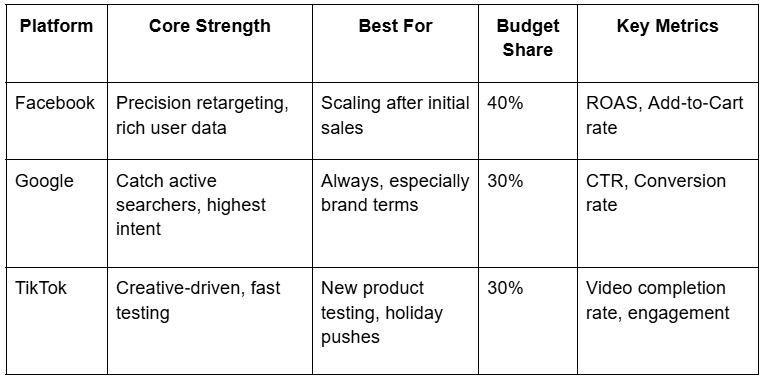
Suggested combos:
- Test new products: start with TikTok’s most punchy creatives to validate potential at low cost.
- Stabilise sales: use Google Shopping ads to steadily capture search traffic and secure baseline orders.
- Scale profit: use Facebook retargeting to bring back people who viewed but didn’t buy, increasing repeat purchase.
Post‑Click Fulfillment Is Where The Real Work Happens – CUSTOMIZINGBOX Saves You 80% of the Hassle
Ads bring orders, but if custom production, packaging, and shipping can’t keep up, refunds and bad reviews will eat all your margins. That’s where CUSTOMIZINGBOX comes in.
How We Support Your Ads
- Automatic order sync: You sell on Shopify, WooCommerce, or Etsy. The names, photos, and custom text your customer enters are automatically passed to our system – no manual export/import.
- 30+ production lines: Apparel, drinkware, jewellery, home decor – wide category coverage. Own factories + partner factories ensure reliable lead times.
- Branded packaging: Custom labels, inserts, handwritten cards. When your customer receives the package, the unboxing experience is top‑notch, boosting repeat purchase rates.
- 20+ shipping options: Integrated with Yun Express, FedEx, DHL, USPS etc., covering EU and US markets. The system automatically picks the best route, cutting logistics costs by ~30%.
- Value‑added services: Product photography, video production, ad creative design – we make them for you, ready to run.
Why This Matters for Your Advertising
- Fulfillment speed affects ad account quality score. Slow delivery or lots of negative feedback will cause Facebook and Google to lower your ad priority. CUSTOMIZINGBOX processes orders same day and keeps shipping times predictable.
- Custom products naturally have higher return rates, but branded packaging and handwritten cards can bring them down significantly. A personalised card makes buyers feel the love – they’re more forgiving of small imperfections.
- Free up your time. Focus on product selection, creatives, and ad strategy. Leave production, packing, and shipping to us. No monthly fee, no transaction fee – you only pay for what is actually produced and shipped.
Common Pitfalls & How to Avoid Them
- Sticking to one platform: Only using Facebook and ignoring Google means missing a huge pool of active searchers. Multi‑platform combos cover the whole funnel.
- Not testing creatives: Running the same creative forever – you never learn what works. Test 3–5 new creatives every week.
- Ignoring mobile experience: 90% of POD store traffic comes from mobile. Customisation forms must work on small screens – big buttons, smooth photo upload.
- No expedited shipping option: In the last few days before a holiday, many buyers are willing to pay for speed. CUSTOMIZINGBOX offers a “fast lane” option; add a “guaranteed delivery by [holiday]” choice in your store and you can increase AOV by 20%.
- Not tracking backend data: Relying only on platform reports without connecting costs to ad data. Use tools like Triple Whale or Hyros to get true ROAS.
One Sentence Summary
Get traffic right, make creative compelling, and keep fulfillment reliable. Handle the front end – choose the right platforms and run good ads – and let CUSTOMIZINGBOX handle production, packing, and shipping. All you need to watch daily is ROAS and customer feedback. Leave the rest to the system.
If you’re still struggling with custom product supply chain, come try CUSTOMIZINGBOX. Starting today, focus on marketing and leave production & shipping to us.
This article is based on major ad platform policies as of 2026. For live campaigns, always refer to the official platform guidelines.
Share on Social Media: