
CUSTOMIZINGBOX Content Team
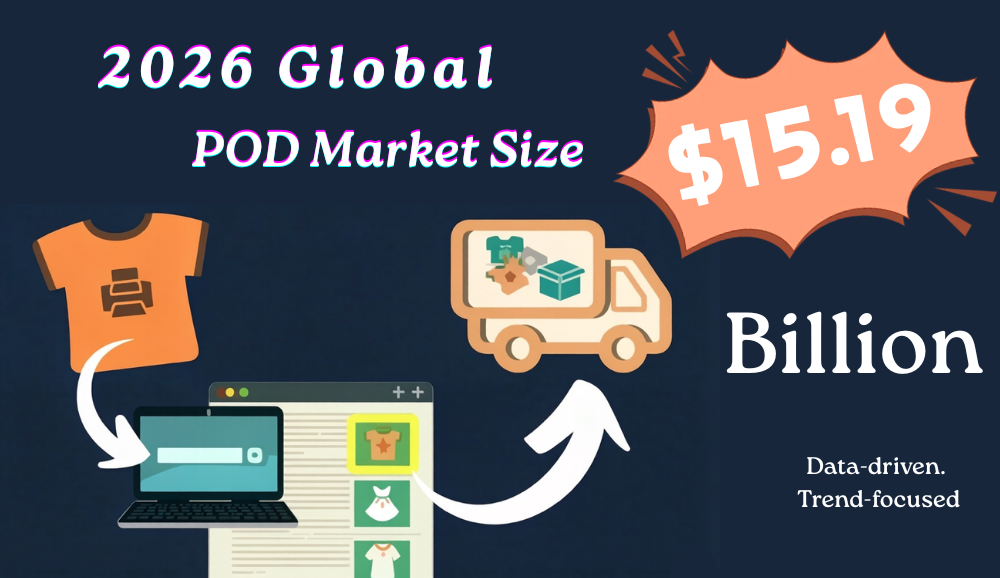
The global POD market is projected to reach $15.19 billion USD in 2026, and is expected to grow to $46.43 billion USD by 2031, at a compound annual growth rate (CAGR) of 25.05%. Meanwhile, sellers using AI design tools are seeing product click-through rates 2–3 times higher than those relying on traditional design methods. In 2026, AI is no longer a “nice‑to‑have” — it is becoming the competitive edge that separates scaling sellers from those buried under a sea of listings.
Below, we break down exactly how to build your AI design stack, follow the latest design trends, and turn prompts into real profit.
The AI Advantage: What's Actually Changed for POD Sellers
Two years ago, creating a sellable design meant either learning graphic design yourself or paying a freelancer. Design creation was always the biggest bottleneck. AI has largely weakened that problem.
In practical terms, this means:
- Volume becomes viable. Instead of 10 designs per week, you can now generate 50–100 per day. More designs mean more opportunities to find winners.
- Testing costs drop to zero. You can test 20 variations of the same concept without paying for each revision. Don‘t like the color palette? Regenerate. Want a different style? Change a few words in the prompt.
- Speed into new niches skyrockets. Spot a trending niche on Monday morning (e.g., pet blankets, Y2K stickers, press‑on nails). By Tuesday, you can have 30 designs uploaded and listed.
- The barrier to entry has never been lower. Tools like Midjourney, Adobe Firefly, DALL‑E 3, and Stable Diffusion let anyone produce high‑quality, original artwork in minutes. You no longer need to be an artist to sell art.
For more advanced sellers, AI design tools that integrate directly with ecommerce workflows allow you to go from idea to published listing in just minutes.
The 2026 AI Design Toolkit: Tools That Actually Work
Not all AI design tools were built for sellers. Here‘s how to choose the right ones for your POD business.
Category 1: AI Image Generators (for Ideation & Concept Creation)
-
- Midjourney – The Quality King
Midjourney consistently produces the most marketplace‑ready designs. Its illustration quality, color accuracy, and style consistency are a step ahead.
- Best for: High‑quality illustrations, vintage/retro styles, detailed artwork
- Pricing: Monthly – Basic 10,Standard10,Standard30, Pro 60,Mega60,Mega120
- Strengths: Best overall image quality; especially good at vintage and illustrated styles that sell well on POD platforms; active community sharing prompts and techniques
- Considerations: Discord‑based interface has a learning curve; no native transparent background output; requires post‑processing before designs are print‑ready
-
- DALL‑E 3 (via ChatGPT) – The Easiest Entry Point
DALL‑E 3 integrated into ChatGPT is the fastest path from idea to design. You can describe your needs conversationally, iterate naturally, and get surprisingly good results.
- Best for: Beginners, quick concept testing, text‑heavy designs
- Pricing: Included in ChatGPT Plus ($20/month)
- Strengths: Conversational interface lowers the prompt learning curve; native transparent background support; surprisingly good at incorporating text into designs
-
- Stable Diffusion – The Customization King
- Best for: Maximum control, no recurring fees
- Pricing: Free, open‑source, infinitely tunable
- Strengths: Everything runs locally; you can train custom models on your own style
- Weaknesses: Requires technical setup and a reasonably powerful computer
Category 2: AI Workflow Tools (Get Designs to Market Fast)
Most AI image generators were built for artists, not for sellers. You might spend 20 minutes crafting the perfect prompt in Midjourney, get a stunning image, and then realize you still need to remove the background, resize it for your product, upload it to your shop, write a title, add tags, and publish. The “AI” part was fast. Everything after it is slow.
Workflow tools solve this — they turn raw AI outputs into ready‑to‑list products.
-
-
- MyDesigns Dream AI – An end‑to‑end seller solution. It generates designs, applies them to product mockups, writes SEO‑optimized listings using Vision AI, and bulk publishes to Etsy or Shopify — all without leaving the platform. It integrates 13+ AI image generation models (including GPT Image 1, Ideogram 3, Flux Kontext Pro, Recraft V4) with no extra subscriptions.
- Canva AI & Kittl AI – Better for beginners. They offer intuitive layout control, simpler editing, and a gentler learning curve for prompts.
- Midjourney + ChatGPT image generation – Strong for concept development, style exploration, composition, and quickly expanding ideas. When used together, they form a closed loop of “creative exploration + precise execution” for POD design. If you want ten different directions for a vintage camping t‑shirt or a pet portrait mug, this combination works well.
-
Quick Rule of Thumb: Use general AI tools (Midjourney, DALL‑E) for ideation, style exploration, and rough asset creation. Use POD‑specific workflow tools for formatting, mockups, listing preparation, and publishing. That split is where real speed lives.
Design Trends Driving Sales Right Now
Pairing AI tools with the right visual trends is your shortcut to higher conversion rates. Here are the design directions POD sellers should watch in 2026.
-
- AI‑Enhanced Handcrafted Aesthetics
AI is not replacing handmade style — it‘s elevating it. Sellers are combining imperfect textures, sketch lines, dynamic brush strokes, and hand‑lettered elements with AI‘s precision and scalability. Think watercolor scenes finished with hand‑lettered names, or sketch‑style pet illustrations turned into line art prints. Shoppers crave authenticity but still love polished aesthetics, and AI helps sellers create consistent visual sets across different products.
-
- Neo‑Nostalgia: 90s and 2000s Revival
Y2K isn‘t going away — it‘s evolving into neo‑nostalgia. This blends retro tech motifs, pixel graphics, bright neon, early‑internet aesthetics with modern gradients and clean typography. Millennials and Gen Z shoppers feel a strong connection to nostalgic visuals, and this style works extremely well for apparel, phone cases, stickers, and mugs.
Product examples: 90s grid background with a customer‘s name in neon font, retro computer UI mockups with custom messages, pixel pet portraits.
-
- Eco‑Inspired Minimalism
Simplicity is back, but with an earthy, grounded twist. Neutral palettes, botanical elements, minimal line art, and textured organic backgrounds are resonating with sustainability‑focused shoppers. This trend shines in home decor categories (posters, canvas prints, ornaments) — even lower‑cost products can look premium.
-
- Hyper‑Personalized Repeat Patterns
Repeat patterns are exploding on POD platforms. Sellers are turning names, dates, pets, and even customer drawings into seamless repeating patterns that can be applied to blankets, apparel, tumblers, and wrapping paper. This approach creates infinite variations with minimal effort and is perfect for upsells and bundles.
Niche Spotlight – AI Pet Products: Pet personalization is already a billion‑dollar market, but the bigger opportunity in 2026 is AI‑transformed pet art, breed‑specific customization workflows, and pet micro‑identities. Products with proven traction include AI‑transformed pet portraits on canvas, blankets, phone cases, and mugs; customizable pet ID tags with illustrations and QR codes; and matching hoodies for pet parents.
Beyond Design: How AI Is Reshaping Product Discovery
AI is changing not only how you design, but also how customers find you.
The zero‑click problem: According to multiple sources, Google‘s AI Overviews caused organic search traffic to drop by an estimated 58% in 2025. The traditional path of publishing optimized pages and gradually building organic traffic may no longer be enough to grow a POD business.
What works now: Successful POD businesses will combine strong merchandising, clear brand positioning, structured product data, and patient customer acquisition strategies — rather than relying solely on cheap traffic or viral designs.
Where to focus your efforts:
-
- Social commerce (TikTok, Instagram) remains the most effective discovery channel for POD products
- Structured product data helps AI shopping assistants understand and recommend your products
- Customer reviews and social proof are more important than ever
Putting It All Together: Your AI Design Workflow
Here is a practical 4‑step workflow to start selling AI‑powered POD products tomorrow.
Step 1: Choose your design tool stack
-
- Ideation & concept: Midjourney or DALL‑E 3
- Print‑ready formatting: MyDesigns Dream AI, Canva AI, or Kittl AI
Step 2: Research your niche
-
- Use AI prompts and keyword tools to identify underserved POD niches
- Spend time researching on marketplaces — sort by “Top Customer Reviews” to see what actually sells
Step 3: Generate designs with commercial use rights
-
- Paid AI tools like Midjourney and DALL‑E 3 grant you commercial rights to the images you generate
- Follow print‑ready specs: transparent backgrounds (PNG), minimum 150 DPI (ideally 300 DPI), print‑safe colors with bold, clear separation
Step 4: List, disclose, and scale
-
- If selling on Etsy: disclose AI use in the listing description
- Connect your POD fulfillment partner to handle printing and shipping
- Upload more designs — volume increases your odds of finding winners
- Monitor which designs perform best and double down on those styles
Final Thoughts: Critical Pitfalls to Avoid
- Using free AI tools without commercial rights – Many free AI image generators do not grant full commercial usage rights. Always check the terms before selling designs generated with free tools. Paid plans (Midjourney, DALL‑E 3, Leonardo AI) typically include commercial rights.
- Paying for too many tools – Sellers can easily spend a significant amount on AI subscriptions each month before making their first sale. Start small, test, then expand.
- Ignoring quality control – 23% of returns come from color mismatch or blurry printing. Order samples before scaling. What looks good on screen doesn‘t always translate well to fabric.
- Relying solely on AI without human editing – The most successful AI‑art shops don‘t just upload raw Midjourney outputs. They refine, remix, recolor, add typography, or combine multiple elements to create unique and defensible designs.
AI design tools won‘t make POD sellers obsolete — they will make sellers who don‘t use them obsolete. The barrier to entry has dropped, but so has the margin for error.
The sellers who win in 2026 won‘t be the ones generating the most images. They‘ll be the ones who combine AI efficiency with smart merchandising, clear brand positioning, and a deep understanding of what their customers actually want. AI can generate 100 designs in an hour, but it can‘t tell you which one will make someone smile, cry, or click “add to cart.” That‘s still on you.
Now go generate, iterate, and start selling. The tools are ready — you just need to start.
Need a reliable fulfillment partner for your AI‑powered custom products? We handle printing, packaging, and worldwide shipping so you can focus entirely on design and marketing.
Share on Social Media: